
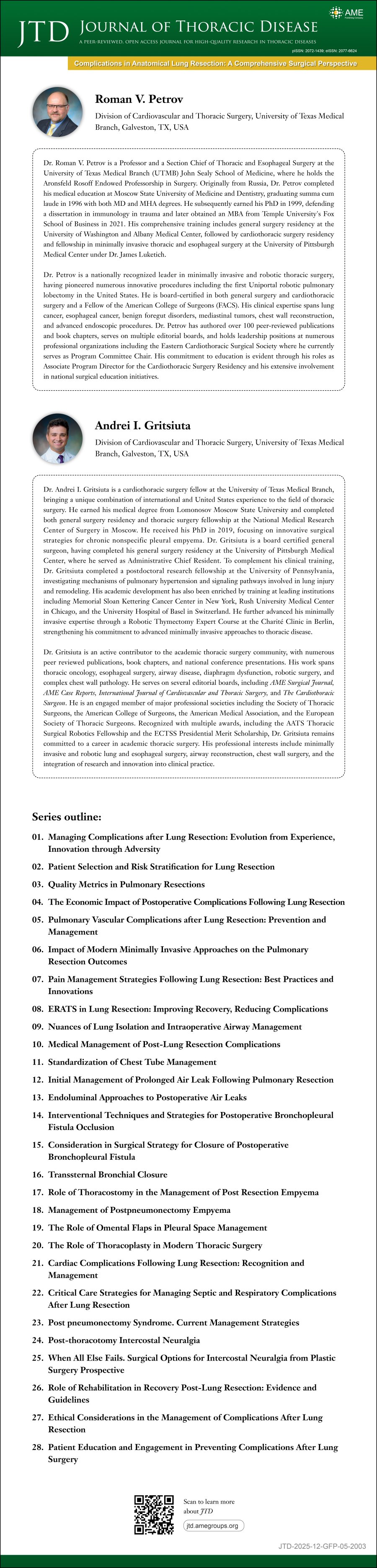
This special series on “Complications in Anatomical Lung Resection: A Comprehensive Surgical Perspective” is co-edited by Drs. Roman V. Petrov and Andrei I. Gritsiuta, from University of Texas Medical Branch, Galveston, TX, USA.
Roman V. Petrov
Division of Cardiovascular and Thoracic Surgery, University of Texas Medical Branch, Galveston, TX, USA
Dr. Roman V. Petrov is a Professor and a Section Chief of Thoracic and Esophageal Surgery at the University of Texas Medical Branch (UTMB) John Sealy School of Medicine, where he holds the Aronsfeld Rosoff Endowed Professorship in Surgery. Originally from Russia, Dr. Petrov completed his medical education at Moscow State University of Medicine and Dentistry, graduating summa cum laude in 1996 with both MD and MHA degrees. He subsequently earned his PhD in 1999, defending a dissertation in immunology in trauma and later obtained an MBA from Temple University's Fox School of Business in 2021. His comprehensive training includes general surgery residency at the University of Washington and Albany Medical Center, followed by cardiothoracic surgery residency and fellowship in minimally invasive thoracic and esophageal surgery at the University of Pittsburgh Medical Center under Dr. James Luketich.
Dr. Petrov is a nationally recognized leader in minimally invasive and robotic thoracic surgery, having pioneered numerous innovative procedures including the first Uniportal robotic pulmonary lobectomy in the United States. He is board-certified in both general surgery and cardiothoracic surgery and a Fellow of the American College of Surgeons (FACS). His clinical expertise spans lung cancer, esophageal cancer, benign foregut disorders, mediastinal tumors, chest wall reconstruction, and advanced endoscopic procedures. Dr. Petrov has authored over 100 peer-reviewed publications and book chapters, serves on multiple editorial boards, and holds leadership positions at numerous professional organizations including the Eastern Cardiothoracic Surgical Society where he currently serves as Program Committee Chair. His commitment to education is evident through his roles as Associate Program Director for the Cardiothoracic Surgery Residency and his extensive involvement in national surgical education initiatives.
Andrei I. Gritsiuta
Division of Cardiovascular and Thoracic Surgery, University of Texas Medical Branch, Galveston, TX, USA
Dr. Andrei I. Gritsiuta is a cardiothoracic surgery fellow at the University of Texas Medical Branch, bringing a unique combination of international and United States experience to the field of thoracic surgery. He earned his medical degree from Lomonosov Moscow State University and completed both general surgery residency and thoracic surgery fellowship at the National Medical Research Center of Surgery in Moscow. He received his PhD in 2019, focusing on innovative surgical strategies for chronic nonspecific pleural empyema. Dr. Gritsiuta is a board certified general surgeon, having completed his general surgery residency at the University of Pittsburgh Medical Center, where he served as Administrative Chief Resident. To complement his clinical training, Dr. Gritsiuta completed a postdoctoral research fellowship at the University of Pennsylvania, investigating mechanisms of pulmonary hypertension and signaling pathways involved in lung injury and remodeling. His academic development has also been enriched by training at leading institutions including Memorial Sloan Kettering Cancer Center in New York, Rush University Medical Center in Chicago, and the University Hospital of Basel in Switzerland. He further advanced his minimally invasive expertise through a Robotic Thymectomy Expert Course at the Charité Clinic in Berlin, strengthening his commitment to advanced minimally invasive approaches to thoracic disease.
Dr. Gritsiuta is an active contributor to the academic thoracic surgery community, with numerous peer reviewed publications, book chapters, and national conference presentations. His work spans thoracic oncology, esophageal surgery, airway disease, diaphragm dysfunction, robotic surgery, and complex chest wall pathology. He serves on several editorial boards, including AME Surgical Journal, AME Case Reports, International Journal of Cardiovascular and Thoracic Surgery, and The Cardiothoracic Surgeon. He is an engaged member of major professional societies including the Society of Thoracic Surgeons, the American College of Surgeons, the American Medical Association, and the European Society of Thoracic Surgeons. Recognized with multiple awards, including the AATS Thoracic Surgical Robotics Fellowship and the ECTSS Presidential Merit Scholarship, Dr. Gritsiuta remains committed to a career in academic thoracic surgery. His professional interests include minimally invasive and robotic lung and esophageal surgery, airway reconstruction, chest wall surgery, and the integration of research and innovation into clinical practice.
Series outline:
- Managing Complications after Lung Resection: Evolution from Experience, Innovation through Adversity
- Patient Selection and Risk Stratification for Lung Resection
- Quality Metrics in Pulmonary Resections
- The Economic Impact of Postoperative Complications Following Lung Resection
- Pulmonary Vascular Complications after Lung Resection: Prevention and Management
- Impact of Modern Minimally Invasive Approaches on the Pulmonary Resection Outcomes
- Pain Management Strategies Following Lung Resection: Best Practices and Innovations
- ERATS in Lung Resection: Improving Recovery, Reducing Complications
- Nuances of Lung Isolation and Intraoperative Airway Management
- Medical Management of Post-Lung Resection Complications
- Standardization of Chest Tube Management
- Initial Management of Prolonged Air Leak Following Pulmonary Resection
- Endoluminal Approaches to Postoperative Air Leaks
- Interventional Techniques and Strategies for Postoperative Bronchopleural Fistula Occlusion
- Consideration in Surgical Strategy for Closure of Postoperative Bronchopleural Fistula
- Transsternal Bronchial Closure
- Role of Thoracostomy in the Management of Post Resection Empyema
- Management of Postpneumonectomy Empyema
- The Role of Omental Flaps in Pleural Space Management
- The Role of Thoracoplasty in Modern Thoracic Surgery
- Cardiac Complications Following Lung Resection: Recognition and Management
- Critical Care Strategies for Managing Septic and Respiratory Complications After Lung Resection
- Post pneumonectomy Syndrome. Current Management Strategies
- Post-thoracotomy Intercostal Neuralgia
- When All Else Fails. Surgical Options for Intercostal Neuralgia from Plastic Surgery Prospective
- Role of Rehabilitation in Recovery Post-Lung Resection: Evidence and Guidelines
- Ethical Considerations in the Management of Complications After Lung Resection
- Patient Education and Engagement in Preventing Complications After Lung Surgery
Disclosure:
The series “Complications in Anatomical Lung Resection: A Comprehensive Surgical Perspective” was commissioned by the editorial office, Journal of Thoracic Disease without any sponsorship or funding. Roman V. Petrov and Andrei I. Gritsiuta are serving as the unpaid Guest Editors for the series.