Editorial
Thoracic drain management using a digital system
Journal of Thoracic Disease
2023;
15
(2)
:219-222
.
(28 February 2023)

Does the maze procedure predispose to acute kidney injury?
Journal of Thoracic Disease
2023;
15
(2)
:223-225
.
(28 February 2023)
Incidence of bronchopleural fistula after pneumonectomy in an era of revolution
Journal of Thoracic Disease
2023;
15
(2)
:226-228
.
(28 February 2023)
The final frontier of subdiaphragmatic abscess management: should we bury the scalpel?
Journal of Thoracic Disease
2023;
15
(2)
:229-231
.
(28 February 2023)
Adopting the robotic platform for anatomic lung resections: real life lessons for the tech enthusiast
Journal of Thoracic Disease
2023;
15
(2)
:232-234
.
(28 February 2023)
A stitch in time: age impacts survival in repair of atrioventricular septal defects
Journal of Thoracic Disease
2023;
15
(2)
:235-237
.
(28 February 2023)
The pros and cons of uniportal VATS segmentectomy in the treatment of early-stage lung cancer: should the procedure be prioritized?
Journal of Thoracic Disease
2023;
15
(2)
:238-241
.
(28 February 2023)
Thoracoscopic anatomical segmentectomy for early-stage non-small cell lung cancer: minimally invasive surgery involving various approaches
Journal of Thoracic Disease
2023;
15
(2)
:242-245
.
(28 February 2023)
Beyond the limits: journey to feasible and safe uniportal VATS surgery for lung cancer
Journal of Thoracic Disease
2023;
15
(2)
:246-249
.
(28 February 2023)
Is a single port enough for the learned thoracic surgeons?
Journal of Thoracic Disease
2023;
15
(2)
:250-252
.
(28 February 2023)
Can major lung resection under local anesthesia become widespread?
Journal of Thoracic Disease
2023;
15
(2)
:253-255
.
(28 February 2023)
Opioid-sparing opportunities in the thoracic surgery pathway
Journal of Thoracic Disease
2023;
15
(2)
:256-259
.
(28 February 2023)
Original Article
Clinical outcomes of immune checkpoint inhibitor therapy for advanced lung adenosquamous carcinoma
Journal of Thoracic Disease
2023;
15
(2)
:260-269
.
(28 February 2023)
Anatomic lung resection after immune checkpoint inhibitors for initially unresectable advanced-staged non-small cell lung cancer: a retrospective cohort analysis
Journal of Thoracic Disease
2023;
15
(2)
:270-280
.
(28 February 2023)
First insights into the role of wall shear stress in the development of a distal stent graft induced new entry through computational fluid dynamics simulations
Journal of Thoracic Disease
2023;
15
(2)
:281-290
.
(28 February 2023)
Ex-vivo exploration of an endobronchial sentinel lymph node procedure in lung cancer for optimizing workflow and evaluating feasibility of novel imaging tools
Journal of Thoracic Disease
2023;
15
(2)
:291-299
.
(28 February 2023)
Interleukin-11 in idiopathic pulmonary fibrosis: predictive value of prognosis and acute exacerbation
Journal of Thoracic Disease
2023;
15
(2)
:300-310
.
(28 February 2023)
Inflammatory myositis-associated interstitial lung disease can be distinguished from that associated with other connective tissue diseases
Journal of Thoracic Disease
2023;
15
(2)
:311-322
.
(28 February 2023)
When to proceed to surgical rib fixation?—A single-institution clinical experience
Journal of Thoracic Disease
2023;
15
(2)
:323-334
.
(28 February 2023)
Uniportal vs. multiportal thoracoscopic segmentectomy: a north American study
Journal of Thoracic Disease
2023;
15
(2)
:335-347
.
(28 February 2023)
Global trends in the burden of esophageal cancer, 1990−2019: results from the Global Burden of Disease Study 2019
Journal of Thoracic Disease
2023;
15
(2)
:348-364
.
(28 February 2023)
Laboratory blood test profiling reveals distinct biochemical and hemocyte features of KRAS mutated non-small cell lung cancer
Journal of Thoracic Disease
2023;
15
(2)
:365-375
.
(28 February 2023)
Risk factors for postoperative cerebral infarction in patients after lung resection: a single-center case-control study
Journal of Thoracic Disease
2023;
15
(2)
:376-385
.
(28 February 2023)
Immunocyte count combined with CT features for distinguishing pulmonary tuberculoma from malignancy among non-calcified solitary pulmonary solid nodules
Journal of Thoracic Disease
2023;
15
(2)
:386-398
.
(28 February 2023)
Recipient, donor, and surgical factors leading to primary graft dysfunction after lung transplant
Journal of Thoracic Disease
2023;
15
(2)
:399-409
.
(28 February 2023)
Tracheostomy insertion in COVID-19: insertion practice and factors leading to unplanned tube exchange
Journal of Thoracic Disease
2023;
15
(2)
:410-422
.
(28 February 2023)
Contemporary real-world radiotherapy outcomes of unresected locally advanced non-small cell lung cancer
Journal of Thoracic Disease
2023;
15
(2)
:423-433
.
(28 February 2023)
Incidence and diagnostic validity of difficult airway in emergency departments in China: a cross-sectional survey
Journal of Thoracic Disease
2023;
15
(2)
:434-441
.
(28 February 2023)
Comparison of lymph node metastasis pattern from esophagogastric junction adenocarcinoma versus very low thoracic esophageal squamous cancer: a propensity-matched analysis
Journal of Thoracic Disease
2023;
15
(2)
:442-451
.
(28 February 2023)
Real-world experience of arbidol for Omicron variant of SARS-CoV-2
Journal of Thoracic Disease
2023;
15
(2)
:452-461
.
(28 February 2023)
Clinical features of recurrent spontaneous pneumomediastinum
Journal of Thoracic Disease
2023;
15
(2)
:462-471
.
(28 February 2023)
Impaired exercise capacity in individuals with non-obstructive small airway dysfunction
Journal of Thoracic Disease
2023;
15
(2)
:472-483
.
(28 February 2023)
Initial Asian experience of the branched E-vita open NEO in complex aortic pathologies
Journal of Thoracic Disease
2023;
15
(2)
:484-493
.
(28 February 2023)
Dyspnea in patients with stage IV non-small cell lung cancer: a population-based analysis of disease burden and patterns of care
Journal of Thoracic Disease
2023;
15
(2)
:494-506
.
(28 February 2023)
Lessons learned by thoracic surgeons during the COVID-19 pandemic
Journal of Thoracic Disease
2023;
15
(2)
:507-515
.
(28 February 2023)
Honeycomb lung is a major risk factor for preoperative radiological tumor size underestimation in patients with primary lung cancer
Journal of Thoracic Disease
2023;
15
(2)
:516-528
.
(28 February 2023)
MicroRNA-186-5p inhibits H9c2 cells apoptosis induced by oxygen-glucose deprivation by targeting ERK1/2
Journal of Thoracic Disease
2023;
15
(2)
:529-541
.
(28 February 2023)
Real-world evidence of safety and influence for lung cancer surgery under COVID-19 pandemic in Japan
Journal of Thoracic Disease
2023;
15
(2)
:542-551
.
(28 February 2023)
Removing different number of regional lymph nodes affects survival outcomes of operable patients at stage IIA non-small cell lung cancer (according to the 8th edition staging)
Journal of Thoracic Disease
2023;
15
(2)
:552-567
.
(28 February 2023)
Standardization of intra- and peri-operative management to reduce postoperative drainage time after major thoracoscopic pulmonary resections
Journal of Thoracic Disease
2023;
15
(2)
:568-578
.
(28 February 2023)
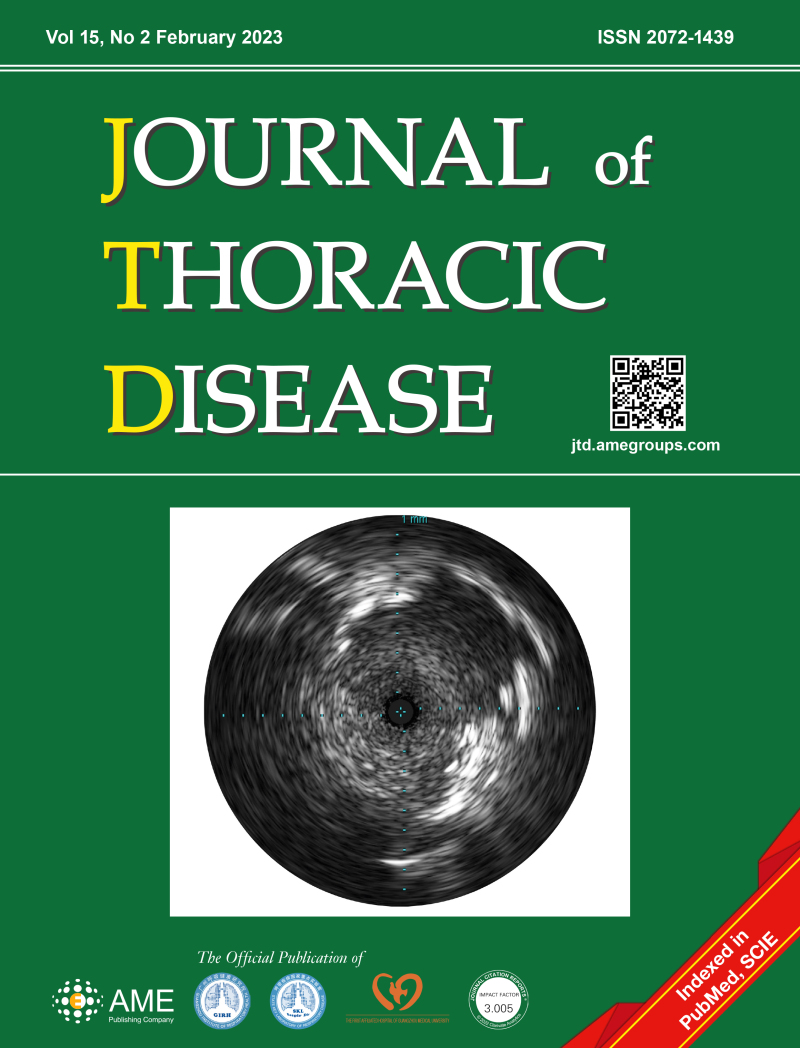
Cone-beam computed tomography-guided endobronchial ultrasound using an ultrathin bronchoscope for diagnosis of peripheral pulmonary lesions: a prospective pilot study
Journal of Thoracic Disease
2023;
15
(2)
:579-588
.
(28 February 2023)
Polymorphisms in the FCER2 gene have associations with asthma and chronic obstructive pulmonary disease
Journal of Thoracic Disease
2023;
15
(2)
:589-599
.
(28 February 2023)
The relationship between tumor infiltrating immune cells and the prognosis of patients with lung adenocarcinoma
Journal of Thoracic Disease
2023;
15
(2)
:600-610
.
(28 February 2023)
Relationship between valvular structure and biochemical indices of non-valvular atrial fibrillation and senile degenerative valvular heart disease
Journal of Thoracic Disease
2023;
15
(2)
:611-619
.
(28 February 2023)
Risk factor analysis of postoperative cerebral infarction in thoracic surgery patients by propensity-score matching-a single institution retrospective cohort study
Journal of Thoracic Disease
2023;
15
(2)
:620-626
.
(28 February 2023)
The value of serum Sema4D level in reflecting the inflammatory state of acute ST-segment elevation myocardial infarction
Journal of Thoracic Disease
2023;
15
(2)
:627-634
.
(28 February 2023)
Value of contrast-enhanced magnetic resonance imaging-T2WI-based radiomic features in distinguishing lung adenocarcinoma from lung squamous cell carcinoma with solid components >8 mm
Journal of Thoracic Disease
2023;
15
(2)
:635-648
.
(28 February 2023)
Serum vitamin D3 deficiency can affect the efficacy of sublingual immunotherapy in children with allergic rhinitis: a retrospective cohort study
Journal of Thoracic Disease
2023;
15
(2)
:649-657
.
(28 February 2023)
The association of coagulation indicators with in-hospital acute kidney injury and malignant events of patients with acute aortic dissection: a retrospective cohort study
Journal of Thoracic Disease
2023;
15
(2)
:658-667
.
(28 February 2023)
Systematic review and meta-analysis of the risk factors for postoperative delirium in patients with acute type A aortic dissection
Journal of Thoracic Disease
2023;
15
(2)
:668-678
.
(28 February 2023)
Differentiating between pulmonary adenocarcinoma and squamous cell carcinoma by spectral CT volumetric quantitative analysis: a comparative study with conventional spectral analysis
Journal of Thoracic Disease
2023;
15
(2)
:679-689
.
(28 February 2023)
Immune-related thyroid dysfunction is associated with improved long-term prognosis in patients with non-small cell lung cancer treated with immunotherapy: a systematic review and meta-analysis
Journal of Thoracic Disease
2023;
15
(2)
:690-700
.
(28 February 2023)
Postoperative delirium and its influencing factors in elderly patients with lung cancer in the intensive care unit
Journal of Thoracic Disease
2023;
15
(2)
:701-710
.
(28 February 2023)
Short Communication
Is SARS-COV-2 associated with alpha-1 antitrypsin deficiency?
Journal of Thoracic Disease
2023;
15
(2)
:711-717
.
(28 February 2023)
Study Protocol
Neoadjuvant therapy with immunoagent (nivolumab) or placebo plus chemotherapy followed by surgery and adjuvant treatment in subjects with resectable esophageal squamous cell carcinoma: study protocol of a randomized, multicenter, double blind, phase II trial (NATION-2203 trial)
Journal of Thoracic Disease
2023;
15
(2)
:718-730
.
(28 February 2023)
Review Article
Lung cancer with air lucency: a systematic review and clinical management guide
Journal of Thoracic Disease
2023;
15
(2)
:731-746
.
(28 February 2023)
The beginning of a new era in induction treatment for operable non-small cell lung cancer: a narrative review
Journal of Thoracic Disease
2023;
15
(2)
:747-758
.
(28 February 2023)
Esophageal diverticula: from diagnosis to therapeutic management—narrative review
Journal of Thoracic Disease
2023;
15
(2)
:759-779
.
(28 February 2023)
Intrathoracic vacuum therapy for the therapy of pleural empyema—a systematic review and analysis of the literature
Journal of Thoracic Disease
2023;
15
(2)
:780-790
.
(28 February 2023)
Suggested robotic-assisted thoracic surgery training curriculum
Journal of Thoracic Disease
2023;
15
(2)
:791-798
.
(28 February 2023)
Editorial on Clinical Update Sleep 20231
Clinical Update Sleep: Life Eessentials and NHS England ‘Optimal Sleep Pathway’
Journal of Thoracic Disease
2023;
15
(2)
:799-801
.
(28 February 2023)
Original Article on Clinical Update Sleep 20231
Peri-operative outcomes of bariatric surgery in obstructive sleep apnoea: a single-centre cohort study
Journal of Thoracic Disease
2023;
15
(2)
:802-811
.
(28 February 2023)
Cardioprotective medication in Duchenne muscular dystrophy: a single-centre cohort study
Journal of Thoracic Disease
2023;
15
(2)
:812-819
.
(28 February 2023)
The effect of a change from face-to-face to remote positive airway pressure education for patients with sleep apnoea during the coronavirus disease-2019 pandemic: a prospective cohort study
Journal of Thoracic Disease
2023;
15
(2)
:820-828
.
(28 February 2023)
Brief Report on Clinical Update Sleep 20231
Nocturnal continuous positive airway pressure offers symptomatic benefit in excessive dynamic airway collapse despite normal sleep study
Journal of Thoracic Disease
2023;
15
(2)
:829-834
.
(28 February 2023)
Editorial on Prolonged Air Leak after Lung Surgery: Prediction, Prevention and Management2
Prolonged air leak after lung surgery: prediction, prevention and management
Journal of Thoracic Disease
2023;
15
(2)
:835-838
.
(28 February 2023)
A brief appraisal on the GRADE methodology and the development of recommendations on the management of prolonged air leaks by the PALAS Study Group
Journal of Thoracic Disease
2023;
15
(2)
:839-844
.
(28 February 2023)
Editorial Commentary on Prolonged Air Leak after Lung Surgery: Prediction, Prevention and Management2
Should we use a biophysical approach in the classification and management of air leakage after lung resection?
Journal of Thoracic Disease
2023;
15
(2)
:845-848
.
(28 February 2023)
Original Article on Prolonged Air Leak after Lung Surgery: Prediction, Prevention and Management2
Prolonged air leak after video-assisted thoracic anatomical pulmonary resections: a clinical predicting model based on data from the Italian VATS group registry, a machine learning approach
Journal of Thoracic Disease
2023;
15
(2)
:849-857
.
(28 February 2023)
Prolonged air leak after segmentectomy: incidence and risk factors
Journal of Thoracic Disease
2023;
15
(2)
:858-865
.
(28 February 2023)
Risk factors, complications and costs of prolonged air leak after video-assisted thoracoscopic surgery for primary lung cancer
Journal of Thoracic Disease
2023;
15
(2)
:866-877
.
(28 February 2023)
Review Article on Prolonged Air Leak after Lung Surgery: Prediction, Prevention and Management2
Intraoperative prevention and conservative management of postoperative prolonged air leak after lung resection: a systematic review
Journal of Thoracic Disease
2023;
15
(2)
:878-892
.
(28 February 2023)
The role of new staplers in reducing the incidence of air leak
Journal of Thoracic Disease
2023;
15
(2)
:893-900
.
(28 February 2023)
Enhanced recovery after surgery and chest tube management
Journal of Thoracic Disease
2023;
15
(2)
:901-908
.
(28 February 2023)
Prolonged air leak after robotic lung resection: a narrative review
Journal of Thoracic Disease
2023;
15
(2)
:909-917
.
(28 February 2023)
Original Article of Sleep Section3
Effect of switching from continuous to bilevel positive airway pressure on sleep quality in patients with obstructive sleep apnea: the prospective POP IN VAuto study
Journal of Thoracic Disease
2023;
15
(2)
:918-927
.
(28 February 2023)
Original Article of Cough Section
Diagnostic yield of chest radiograph in management of adults with difficult-to-treat chronic cough—retrospective study
Journal of Thoracic Disease
2023;
15
(2)
:928-939
.
(28 February 2023)
Letter to the Editor
Medical thoracoscopy: effective, cheap and safe for empyema
Journal of Thoracic Disease
2023;
15
(2)
:940-941
.
(28 February 2023)
Erratum
Erratum to the effects of hydrogen treatment in a cigarette smoke solution-induced chronic obstructive pulmonary disease-like changes in an animal model
Journal of Thoracic Disease
2023;
15
(2)
:942
.
(28 February 2023)
Disclosure
1. The series “Clinical Update Sleep 2023” was commissioned by the editorial office, Journal of Thoracic Disease without any funding or sponsorship. Joerg Steier served as the unpaid Guest Editor for the series.
2. The series “Prolonged air leak after lung surgery: prediction, prevention and management” was commissioned by the editorial office, Journal of Thoracic Disease and sponsored by Bard Limited. Bard Limited has no interference on the contents of the special series. Roberto Crisci, Alessandro Brunelli, Florian Augustin and Francesco Zaraca served as the unpaid Guest Editors for the series.
3. The series “Sleep Section” was commissioned by the editorial office, Journal of Thoracic Disease without any funding or sponsorship.